
Actually, I got several new toys over the past few weeks.
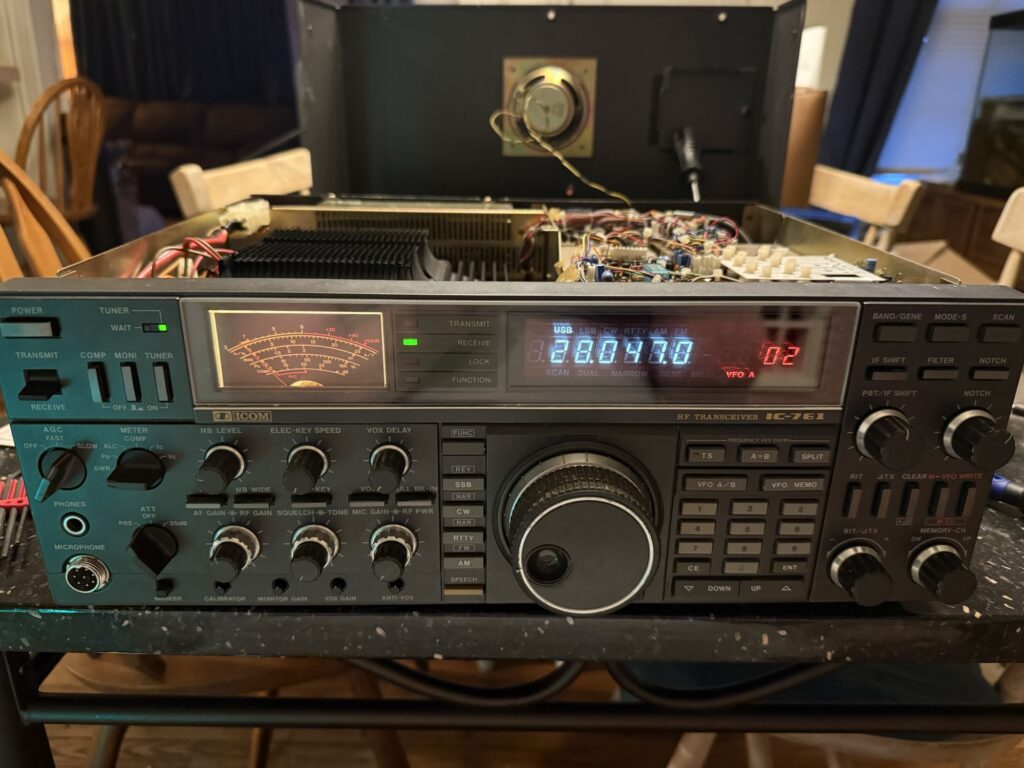
Since getting my general ham radio license back in June, I wanted to expand from my handheld DMR radio and go further. I joined a few HAM groups on Facebook and asked about an older iCom HF transceiver that needed a little bit of work on Facebook marketplace. The transceiver in question was an iCom ic-735. This radio needed a little bit of work, but, it was still functional. These older iComs I have come to learn have a common issue with the VFO knob. The radio I was looking to purchase had a stiff knob. I read up on it and it was a fix that I can easily do myself. While posting about this radio, a local ham, John, N2KJM, who lived a short 30 minute drive from me had an iCom ic-761 he was willing to give me. This radio had the VFO issue which I was able to sort of repair. I am going to need to track down a replacement encoder at some point, as it is still flaky and the hard part is iCom discontinued the part about 20 or so years ago. I am trying to find a dead radio with a good encoder ot a new old stock part. Anyway, I completely disassembled the radio, cleaned all the switches and potentiometers and fixed the antenna tuner circuit. I believe this radio if from 1991, so its got some use on it but is in very good shape for it’s age, John took very good care of this radio. Below is it all running and cleaned up before I put the top cover back on.
Now it was time to get an antenna. I did test very low power using an old Wilson CB antenna. Not the best antenna, but near the 15 meter band, the antenna did OK. The iCom’s antenna tuner handled the mismatch well and was able to achieve a 1.7:1 SWR. Again, I was only pushing about 5 watts so there was no danger to the radio. I tried calling CQ, but due to the low power and not the best antenna, no one heard me. I did have a scanner that I could hear myself on so I know my repairs were successful. Now I needed a good antenna.
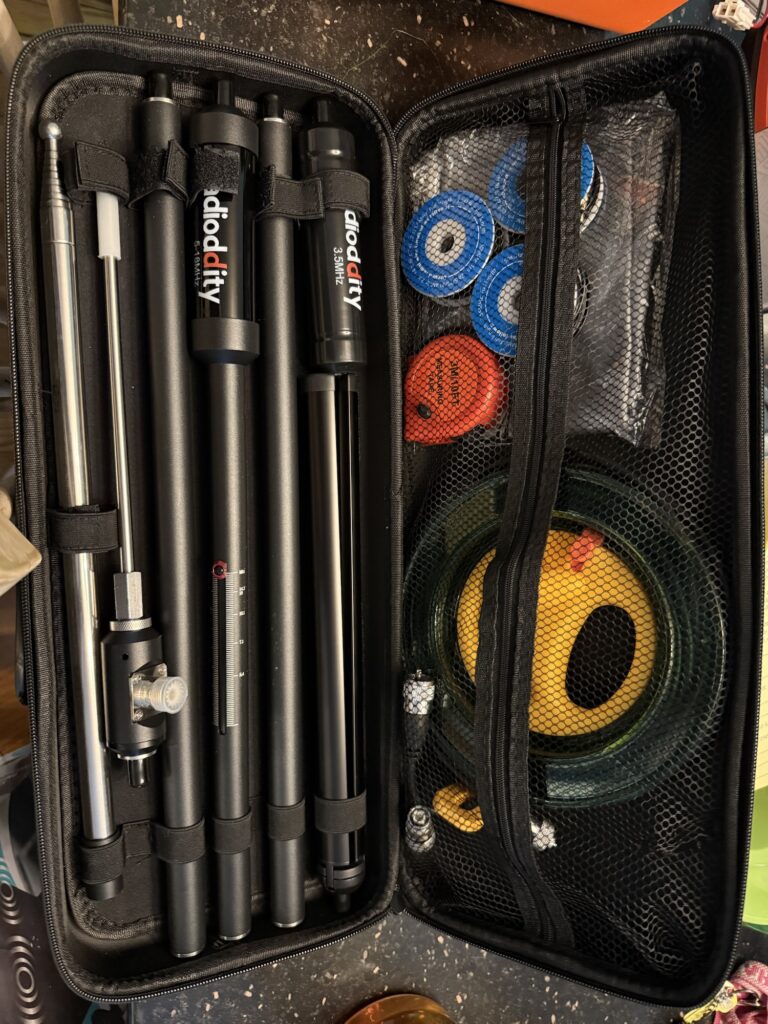
I ended up choosing a Radioditty HF-010.
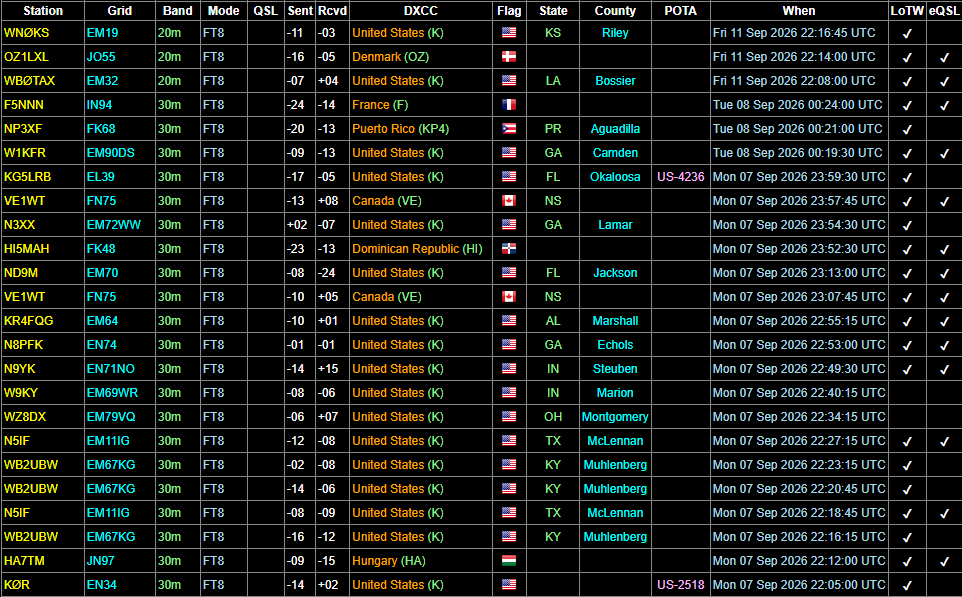
This kit comes with everything you need to get on the air. The instruction manual has most of the settings for the bands the antenna covers. A handy tape measure is included to establish a baseline for the frequency you want to use. An adjustable loading coil as well as an extendable element allows you to get a very resonant antenna across multiple bands. So far, I have used this antenna on 40, 30 and the 20 meter bands. I do not have an antenna analyzer, but will get one in the near future, but using my radio’s SWR meter, I was able to get very favorable 1.3:1 SWR readings without using my radio’s built in antenna tuner. I made a few contacts on FT8 using 75 watts of power. Normally I would not want to push my old transceiver that hard for long, but I wanted to see how my repairs would hold up and the antenna. This antenna is rated at 100 watts PEP. FT8 being a 100% duty cycle mode really tested this antenna. The coil got warm to to the touch but could certainly handle more power than I was pushing to it. I definitely recommend this antenna to anyone who wants a portable setup. There is even a male BNC to female PL-259 adapter if you want to use a QRP radio. I will say though the reel for the coax cable is a little cumbersome, but as I get used to how it works, I am beginning to like it. The settings for the 30m band are sadly absent from the manual, but a little bit of tweaking and adjusting the whip as well as the loading coil to find a sweet spot wasn’t that difficult. This antenna goes for $239 and is well worth the price. This antenna is designed to be portable and not made for permanent installations. The manual says to protect it from weather but I have used it in a light drizzle and this doesn’t seem to effect this antenna in the slightest. This kit comes with a ground spike and a tripod. You can use both at the same time and if you are setting up in a location without soft ground, a water bag is included with the kit to weigh the tripod down.
And then I ran into an issue. Not with the antenna, but my new to me transceiver. The iCom 671 has an internal power supply. Well the years weren’t kind to the power supply. I plugged the radio in and heard a faint pop and click. Dead, no display, no lights, no signs of life. The internal power supply thankfully has a universal output voltage of 13.8 volts DC. I opened up the failed power supply expecting maybe a blown fuse or a loose solder joint, NOPE!!! two of the massive filtering caps burst and burned the entire power supply. I connected 12 volts right to the output of the power supply and the radio came back to life like nothing happened. So I needed a power supply. I had a 350 watt 12 volt MeanWell power supply and was able to adjust the voltage to 13.8 volts and everything is happy again. I did have to fabricate a small bracket so this new power supply fits inside the radio chassis nice. The new supply being a switch mode supply instead of linear keeps the radio cooler. I was using FT8 for several hours driving the power supply and radio hard and it was much cooler and in term, much happier. Some switch mode power supplies can generate interference on the HF bands, but the MeanWell power supplies are well build and I haven’t noticed any noise coming from the power supply other than the noise of the fan kicking on.
In conclusion, I have a solid beginner setup. I am crazy enough to lug this heavy beast of a transceiver around with me, but I have found other people who live seeing vintage gear alive and well going to some amazing places. In the past few days, I have made some really cool contacts all over the world. Once I get comfortable with the digital modes, I’ll definitely move on to Phone (Voice) communications.
73, KE2IRO